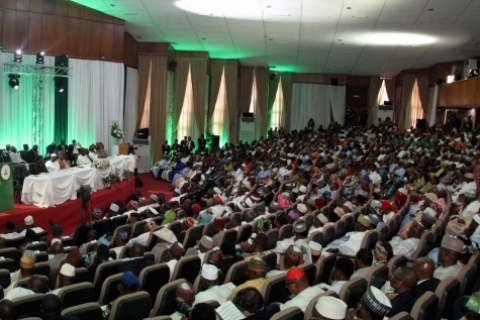
National Conference in plenary
Women delegates at Conference vow to band together,
PLATFORM9JA investigations have shown that women are under represented at the ongoing national conference in Abuja.
There are roughly 78 women out of the 492 delegates attending the
conference, which is less than 20 per cent, and far below the widely
agitated 35 per cent affirmative action plan in Nigeria.
Data from the 2006 National population census shows that out of the
country’s total population of over 140 million, over 71 million are male
while over 69 million are female.
Also according to a United Nations world population report released
in June, 2013, the total population of Nigeria is estimated to be about
173 million, with over 88 million males and over 85 million females.
These data suggest that the difference in the population of male and
females in Nigeria is negligible; therefore the quest for increased
participation in public forums by the women is tenable.
Already, women delegates at the national conference are beginning to feel sidelined by their male counterparts.
There is only one woman among the six principal officers of the
conference, and only three among the 37 elder statesmen nominated by the
presidency.
In the Federal Government’s list of nominees, there are only
six women out of 20 delegates.
Despite being a requirement that one of three nominees from the
states must be a woman, five states – Delta, Edo, Oyo, Rivers and Yobe –
failed to include women among their delegates to the conference.
At the conference proper, when it became apparent that delegates
could not agree on either consensus, two-third majority or 75 per cent
voting procedure, the leadership of the conference decided to call out a
list of 50 delegates whom it would meet with to decide on the matter.
Out of the fifty names, only six were women.
During the plenary session, almost every woman that spoke asked for women to be considered whenever decisions are taken.
There were indications last week that female delegates might be
heading for showdown with their male counterparts over what they
consider the incessant harassment of the Conference Secretary,
Valerie-Janette Azinge.
Mrs. Azinge, her colleagues say, was constantly harassed and nearly
all powers given to her under the proposed Rules of Proceedings were
either amended or given to the Chairman of the Conference, Idris Kutigi.
During plenary on Monday, March 24, it took the intervention of Otu
Duke, a delegate from Cross Rivers State, to stop an amendment which was
proposed to transfer the power to append Mrs. Azinge’s signature on the
Conference Hansard to Mr. Kutigi.
Mr. Duke had argued that it was the duty of the Secretary to produce a
verbatim report of Conference proceedings to the plenary, adding that
Mrs. Azinge should be allowed to sign the document.
“My Lord,” he said, “I move that the secretary of the Conference
should sign the Hansard since it is her responsibility to produce the
document.”
Earlier another delegate, Femi Okurounmu, had openly canvassed that
the powers assigned to the Conference Secretary under the proposed Rules
of Proceedings be transferred to the Chairman.
But the female delegates, who met shortly after Monday’s plenary
sitting, expressed disappointment at the way the male-dominated
Conference treated Mrs. Azinge.
The meeting, which was addressed by a former Minister of Women
Affairs, Josephine Anenih, took a decision to challenge any other
attempt to sideline Mrs. Azinge by their male delegates.
Over 50 women, representing various interest groups and organisations, attended the meeting.
An authoritative source told POLITICS9JA that the women took a
strong position to defend any cause that might affect them at the
Conference.